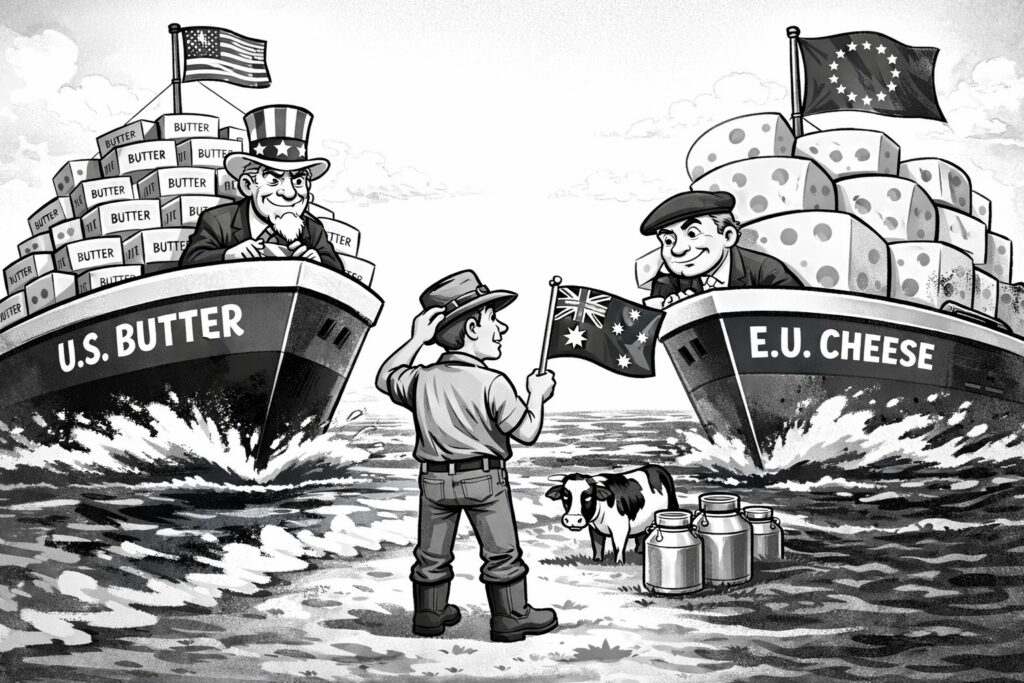
The Australian dairy industry has highlighted serious concerns about deep and lasting consequences for their sector as the Federal Government gears up to sign the Australia-European Union Free Trade Agreement (Australia‑EU FTA).
Australian Dairy Industry Council (ADIC) Chair, Ben Bennett, said it is clear negotiations are effectively complete, but critical dairy outcomes remain unclear and appear heavily weighted in favour of the European Union.
“We think the signing is imminent – the indications we’re getting are that the deal is essentially there,” Mr Bennett said.
Mr Bennett told The Australian the dairy sector once again appears to be left carrying the burden in this agreement, “with more risk, more imports and fewer protections, for very little in return”.
“Dairy is going under the bus, and it’s being driven by Federal Government.”
The industry has warned that the proposed agreement would loosen Australia’s remaining safeguards on European dairy imports, particularly cheese, in a market already exposed to heavily subsidised products from the EU.
Australia currently imports around 80,000 tonnes of dairy from the EU valued at $877.4 million, up almost nine per cent year-on-year, while exporting only around 1,600 tonnes in return valued at $55 million.
“This is not a level playing field,” Mr Bennett said.
“European dairy producers receive tens of billions of dollars in subsidies, yet Australian farmers are being asked to compete without such support.”
ADIC is also concerned about the potential removal of the $1.20 per kilogram tariff on imported cheese, which the industry describes as the last meaningful buffer against a surge of low‑priced European product.
“The risk is not theoretical. The EU is the world’s largest cheese producer by a country mile, and surplus product will inevitably be pushed into markets like Australia if barriers are lowered.”
Beyond imports, the dairy industry remains alarmed by the prospect of Geographical Indications (GIs) restricting the use of long‑established dairy names such as parmesan and feta, which underpin many Australian processing businesses and regional jobs.
ADIC Deputy Chair John Williams said the industry cannot accept an overseas regulatory regime being imposed on Australian businesses through geographical indications.
“Banning long-used names like parmesan and feta would hit local manufacturers, confuse consumers, and deliver no clear benefit to Australia,” Mr Williams said.
“We need safeguards that actually work.”
ADIC reiterated its support for open, rules‑based trade, but said any agreement must deliver genuine, reciprocal outcomes and include effective safeguards to protect local producers from import surges and unfair competition.
“The government must lock in binding, time-bound review mechanisms that assess impacts on dairy and trigger corrective action where harm occurs,” Mr Williams said.
“The government must also pursue compensation gains elsewhere – through accelerated trade opportunities, long-overdue reviews and improvements to existing agreements so dairy is not left carrying the cost of this deal.
“This is bigger than one negotiation. Dairy contributes $18.5 billion to the national economy and supports more than 70,000 jobs, mostly in regional Australia.
“With European Commission President Ursula von der Leyen visiting Australia in the coming weeks, we are ready to work with government in good faith on a deal that is fair, enforceable and future-ready.”
Mr Bennett said free trade agreements must be free and fair.
“The EU wants access to Australia’s market but is unwilling to reciprocate with equal access to the EU for Australia’s exports – this is clearly inequitable and unfair,” Mr Bennett said. “The agreement on the table is a one-way deal that will leave local industry carrying the cost, and that’s something that should not be acceptable to the Federal Government.”