Posts by

Administrator

Home / Blog Archive
Uncategorized

ADIC seeking Independent Chair for Dairy Animal Care Assurance Program

The Australian Dairy Industry Council (ADIC) seeks an independent Chair for the development phase of its new industry‑led, science‑based Animal Care Assurance Program (ACAP).

The program is being designed to meet regulatory expectations, reflect current science and on‑farm practice, support ongoing improvement, and build trust across the value chain, from dairy farmers to consumers.

Expressions of interest are now being accepted for this important position.

The Chair will provide impartial, strategic leadership, guide constructive and outcome‑focused discussions, and support the Steering Committee to deliver clear, evidence‑based recommendations to ADIC. For more information, please read the position description below, or download it here.


Position Description: Independent Chair – Dairy Animal Care Assurance Program (ACAP) Steering Committee 

Context 

The Australian Dairy Industry Council (ADIC) is developing an industry-led, science-based Animal Care Assurance Program (ACAP) for the Australian dairy sector. ACAP is designed to meet regulatory expectations, reflect current science, commercial practice, support ongoing improvement, and build trust across the value chain—from farmer to consumer. Development commenced in September 2025, with key stages progressing through 2026, and is supported by dairy farmers, animal welfare experts, veterinarians, processors, and key supply chain partners.  

Role Purpose 

ADIC seeks an independent Chair to lead the ACAP Steering Committee through the program’s development phase. The Chair will provide impartial, strategic leadership to guide and facilitate the Steering Committee’s deliberations in achieving the Steering Committee and ADIC goals and objectives. The Chair will foster constructive discussion and debate with the purpose of bringing diverse stakeholder views and perspectives together to deliver clear, consensus-based recommendations for ADIC’s decision-making. 

Key Responsibilities 

  • Facilitate the ACAP Steering Committee in setting its strategic objectives and plans to enable ACAP to achieve its ultimate goals   
  • Set agendas and priorities for Steering Committee meetings 
  • Facilitate focused, outcome-driven discussions and guide the Committee toward consensus-based recommendations 
  • Identify matters requiring escalation to ADIC and clearly articulate options, risks, and implications 
  • Ensure advice provided to ADIC is robust and balanced 
  • Support adherence to agreed governance processes, timelines, and stage-gate requirements 
  • Contribute to stakeholder engagement and relationship management 
  • Act as a spokesperson for ACAP during the development phase, as agreed with ADIC     

Outcomes by End of Appointment 

At the conclusion of the engagement, the independent Chair will have: 

  • Led the Steering Committee through the development of ACAP Version 1, resolving key strategic and technical issues and delivering a clear set of recommendations ready for ADIC endorsement 
  • Established effective committee ways of working that enable constructive challenge, timely progress, and stakeholder confidence 
  • Supported alignment across farmers, processors, veterinarians, and animal welfare experts 
  • Contributed to positioning ACAP as a credible, science-based, and trusted assurance framework 

Authority 

The independent Chair does not hold formal decision-making authority for ACAP but is empowered to shape the Committee’s workplan, guide its deliberations, and ensure high-quality advice is presented to ADIC for decision. 

Current governance arrangements 

The development of ACAP is overseen by a Steering Committee and supported by a Technical Advisory Group (TAG).  

  • The Steering Committee provides strategic direction, governance, and oversight for the national Animal Care Assurance Program, leading the co-development of program standards and the assessment framework, with final approval held by ADIC; it comprises representatives from ADF, ADPF, Australian Cattle Veterinarians, independent farmers, and processors. 
  • The TAG provides independent, science-informed and practical technical advice for Steering Committee consideration and is made up of animal welfare and health scientists, a practicing veterinarian, a milk processor representative, and dairy producers. 

Secretariat support to both committees is provided by Dairy Australia, who have commissioned ACER Consulting to provide expert technical advisory services. The independent Chair will work closely with the TAG Chair and Secretariat to ensure appropriate flow of information, clear delineation of roles, and alignment between technical advice and Steering Committee deliberations. 

Australian Dairy Industry Council, and their two constituent bodies Australian Dairy Farmers and Australian Dairy Products Federation, are the owners of any future ACAP and final decision makers.  

Independent Chair Role 

ADIC are seeking an independent chair to lead the Steering Committee. The Chair will be responsible for guiding the Steering Committee toward clear recommendations, ensuring readiness for stage gate decisions, and supporting ADIC with balanced, evidence based advice. In addition to chairing meetings, this role will include stakeholder engagement and may involve being a key spokesperson for an ACAP during this early development phase, where representation is required and authorised by ADIC.  

Estimated days: 10 across the remainer of 2026 with possible extension into 2027.  

This is a remunerated role in accordance with Dairy Australia committee sitting-fee policy. Respondents are asked to submit their reasonable expectation for a daily rate noting it is not assured this will be the rate offered. 

Meetings will be held at least monthly but ad hoc meetings may be required, meetings will be a combination of face-to-face and remote. 

The Chair must be independent of Dairy Australia and dairy industry representative organisations (i.e., not a current employee, Executive member or Director). 

Competencies sought for the Chair include: 

  • Strong leadership, facilitation and stakeholder communication and engagement skills. 
  • Proven experience chairing committees or boards. 
  • Experience leading or overseeing assurance, certification, or standards based programs in regulated or high trust environments would be well regarded. 
  • Experience navigating community trust, social licence, or NGO scrutiny. 
  • Broad understanding of the agricultural supply chain. 
  • Strategic, innovative and solutions-focused thinking. 
  • Availability and commitment to the role. 

Selection criteria 

Along with the competencies listed above, applicants should demonstrate: 

  • Relevant sector expertise (dairy or agricultural supply chain). 
  • Strategic leadership and governance capabilities. 
  • Strong communication, collaboration and decision-making skills. 
  • Commitment to the objectives of ACAP. 

An ADIC selection committee will be established to assess candidates against prescribed criteria and will make a recommendation to ADIC for ratification.  

Conflicts of interest 

Respondents are asked to disclose any actual, potential or perceived conflicts of interest as part of their application.  

How to apply 

Interested parties are invited to submit: 

  • A brief cover letter (no more than two pages) outlining their interest and addressing the selection criteria. 
  • A curriculum vitae (CV). 
  • Expectation for a daily rate noting it is not assured this will be the rate offered. 
  • Any actual, potential or perceived conflicts of interest. 
  • Contact details for at least two referees. 

Successful applicants will be required to enter into a contract for their roles with Dairy Australia. 

Timeline 

Closing date for applications: 8 May 2026 

Role commences: 10 June 2026  

Further information 

For further information or to apply, please contact Andy Hancock – Dairy Australia – andrew.hancock@dairyaustralia.com.au 

Uncategorized

Unfair trade deal doesn’t stack up for dairy

By Ben Bennett – President, Australian Dairy Farmers

When I’m not travelling on ADF business, I spend my days on a dairy farm and like most farmers I assess things against a simple measure – does it make our industry stronger, more competitive, and more secure into the future?

As I sit down to write this piece, the full details of the agreement have not yet been made public, but I cannot see how it will benefit our industry in any of those ways.

Dairy farmers backed the idea of a deal with Europe. We understood the opportunity.

It’s one of the most protected markets in the world, and if we could get fair access, there was real upside for Australian dairy.

But that was always the condition. It had to be fair, and it had to be reciprocal.

What’s been delivered doesn’t meet that test.

Australia walked away from a deal in Osaka in 2023 because it didn’t stack up.

What’s on the table now doesn’t materially improve on that position. After eight years of negotiations, farmers were expecting something better; not the same deal dressed up differently.

On paper, there’s tariff reductions into Europe, and that sounds positive. But when you dig into it, the reality is those opportunities are still heavily constrained.

The quotas are small, and outside those quotas the tariffs remain so high they effectively shut the door.

So, for most Australian dairy farmers, access to Europe doesn’t change in any meaningful way.

At the same time, Australia is opening its doors, removing tariffs on key products like cheese over just three years.

That’s not a level playing field.

European farmers are supported by tens of billions of euros in subsidies every year.

On average, those subsidies make up a significant portion of farm income. That support shapes how much they produce, what they export, and at what price.

Australian farmers don’t have that.

So what we’re doing here is exposing one of the least subsidised industries in the world to one of the most supported, without getting equal opportunity in return.

That’s not free trade. That’s uneven competition.

Then there’s geographical indications, something farmers have been raising concerns about from the start.

Australia has agreed to protect nearly 400 European product names. Yes, we’ve held onto ‘parmesan’, and existing users of terms like feta and gruyere will be able to continue.

But the direction is clear,  future Australian producers will be restricted in how they describe their products.

That creates cost, complexity, and confusion.

For farmers, it’s another example of giving something up without getting enough back.

One of the biggest concerns for me is what this means for our domestic industry.

Cheese is a cornerstone of Australian dairy processing. It supports regional jobs, investment, and ultimately farmgate milk prices.

The tariff on cheese imports has been one of the last meaningful protections we’ve had. This deal removes it.

We’re already seeing strong growth in imports from Europe. They now send us significantly more dairy than we send back, both in value and volume. This agreement risks accelerating that trend.

And once that happens, once processing capacity shrinks and supply chains shift, it’s very hard to rebuild.

There are safeguard provisions in the deal, but they rely on proving serious harm after it’s already happened. For a perishable product like milk, that’s too late.

Farmers can’t turn production on and off overnight. You don’t recover lost capacity quickly.

That’s why dairy farmers are deeply disappointed.

This deal delivers cheaper luxury cars into Australia, but it doesn’t deliver meaningful new opportunities for the people producing one of the country’s most important staple foods.

Where to from here?

If this agreement is going ahead, we need to make sure Australian dairy isn’t left carrying the cost.

We need stronger support for domestic demand, backing Australian product on Australian shelves.

We need better monitoring of imports and pricing behaviour. And we need to make sure trade policy and domestic policy are working together, not against each other.

Because at the end of the day, this isn’t just about trade deals.

It’s about making sure Australia can keep producing its own food, supporting regional communities, and backing the farmers who do it.

On that measure, this deal doesn’t go far enough.

Uncategorized

Time to get real on dairy terms

By Ben Bennett – President, Australian Dairy Farmers

Have you ever seen anyone attach milking cups to a coconut, or herd almonds into a dairy shed?

It might sound flippant, but the question cuts to the heart of a serious issue Australia continues to ignore – one the rest of the world has resolved and committed to.

Last month, the United Kingdom’s Supreme Court confirmed that products made from plants cannot be called “milk”, “butter” or “yoghurt” if they are not derived from animals.

The ruling reinforces long‑standing laws across the UK, the European Union (EU) and the United States (US) that reserve dairy terms for dairy products.

Yet in Australia, our government has chosen a different path. Instead of clear, enforceable rules, it has endorsed a voluntary labelling code for plant‑based products – one to be written by the plant‑based industry itself.

That decision leaves Australia increasingly out of step with global standards.

This is about honesty, not choice.

Australian Dairy Farmers (ADF) is not calling for plant‑based products to be removed from supermarket shelves. Consumers should have choice.

But choice only works when information is clear and honest.

Milk, cheese and yoghurt are whole foods. They come from a single, natural source and have earned consumer trust over generations.

They also have a well‑understood nutritional profile that matters, particularly for children, older Australians and vulnerable groups.

Plant‑based engineered  products are different. They are formulated to mimic the taste and appearance of dairy. While many are fortified with vitamins and minerals, they are not nutritionally equivalent.

Some are highly processed and engineered through additives to approximate what dairy provides naturally.

When these products use dairy terms, they trade on dairy’s reputation and trust while offering something fundamentally different.

Consumers may know that a product labelled “oat milk” comes from oats. But that is not the same as understanding it does not deliver the same nutrition as milk.

That distinction matters.

The Federal Government recently spent $1.5 million on a labelling review led by the Department of Agriculture, Fisheries and Forestry, with Food Standards Australia New Zealand commissioned to survey consumers.

The review concluded there was limited consumer confusion. Australian Dairy Farmers strongly disputes that finding.

The survey focused largely on whether consumers could identify whether a product was plant‑based.

It did not meaningfully test whether people understand the nutritional differences between dairy and imitation products, or whether they believe these products offer the same health benefits.

Industry was not given the opportunity to provide input into key questions posed to consumers.

Reporting was later drafted in ways that downplayed earlier findings indicating confusion around nutrition.

If you don’t ask honest questions, you won’t get honest answers.

Instead of addressing these shortcomings, the government endorsed the development of a voluntary code of practice led by the Alternative Proteins Council.

This approach is fundamentally flawed.

You cannot ask an industry that imitates genuine products to write the rules governing how dairy language should be used.

That is a clear conflict of interest.

A voluntary code is not regulation. It provides no certainty and no protection for consumers or farmers. Companies that choose not to sign up can continue as they always have.

Yet again, the fox is being asked to build the hen house.

What makes this situation even more baffling is that Australia helped shape the international Codex standards, which define milk as “the normal mammary secretion obtained from the milking of animals”.

We accept those standards in international trade negotiations. We rely on them when exporting Australian dairy into markets that fiercely protect dairy terms.

But at home, we refuse to apply the same logic.

Australia is a major dairy exporter. Failing to protect dairy terms domestically undermines our credibility and weakens the standing of Australian dairy in global markets where those words are legally protected.

Our trading partners understand the value of dairy terms. Why doesn’t our own government?

Across the EU, the UK and the US, plant‑based products can be sold freely – but they cannot be called milk or yoghurt. They may use descriptors like “alternative” or “style”, but the core dairy terms remain reserved for dairy.

This is not radical. It is common sense.

Words matter. When consumers pick up a product labelled “milk”, it should come from a cow – not a marketing department.

The rest of the world recognises that dairy words have meaning. Australia should too.

Farming operations

The H5N1 unicorn… for now

By Justin Toohey – Animal Health, Welfare and Biosecurity Advisor, Australian Dairy Farmers

For several years now, Australia has watched Highly Pathogenic Avian Influenza (H5N1) sweep through bird populations across nearly every continent.

Remarkably, to date we remain the only continent free of the virus.

That absence is good news, but it’s also the core reason dairy farmers must stay alert.

Although H5N1 has never been detected in Australia’s wildlife, poultry or cattle, the global pattern is clear.

The unprecedented outbreak in the US dairy herds in 2024 has given us a valuable insight into how the virus behaves in cattle, and how we can best prepare should it eventually arrive here.

While there is a relatively low risk of the disease entering the Australian dairy herd, we must heed the US experience that saw it as the only continent where H5 bird flu directly impacted dairy cattle and their handlers.

US dairy herds have proved particularly vulnerable to the spread of this disease for several reasons.

Compared with Australian dairy farms, they tend to involve shed-based rather than pasture-based systems, with significantly higher movements of people and cattle, including lactating cattle, between operations.

While the risk profile of Australia’s dairy industry is fundamentally different, we must still be vigilant.

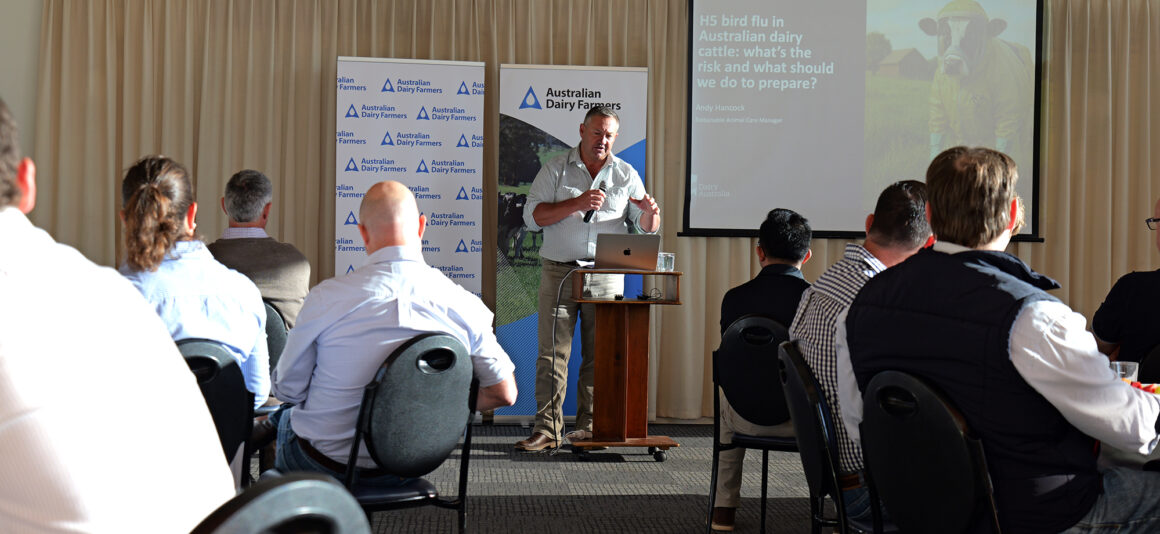
This very topic was the focus of a recent industry breakfast held by Australian Dairy Farmers (ADF) at International Dairy Week.

Guest speaker, Dairy Australia’s Dr Andy Hancock, outlined how the US was caught off guard and what we can learn from the US for application here.

This ties in with work last year by Dairy Australia and the Department of Agriculture, Fisheries and Forestry, studying the risks of H5 bird flu to the domestic dairy herd.

It was evident from this presentation that, in the event of H5N1 arriving in Australia, much can be done by dairy farmers to reduce the risk of infection and/or spread among their herds and farm workers. Key recommendations were:

Prevent entry (spillover) by:

  1. Keeping poultry away from milking bails
  2. Monitoring wild bird populations on farm and requesting tests if any suspicion
  3. Where possible, minimising access of wild birds, poultry and other animals to dairy cattle feed and water sources
  4. Updating and applying on-farm biosecurity plans
  5. Being alert and reporting promptly any illness in cattle, workers or pets

Reduce within-farm spread by:

  1. Observing strict hygiene practices, especially on entry and exit of sheds and during milking
  2. Not feeding mastitis-affected milk to calves or pets
  3. Preferably treating all milk before feeding it to calves or pets
  4. Implementing early detection and isolation of infected animals

Reduce between-farm spread by:

  1. Minimising animal and people movements
  2. Observing strict biosecurity measures, including self-quarantining where possible
  3. Avoiding the movement of raw milk between farms

Reduce the impact by:

  1. Preparing early for the treatment of sick animals
  2. Seriously considering the use of appropriate personal protective equipment
  3. Ensuring no human consumption of raw milk
  4. Maximising the chance of early detection by increasing surveillance and testing

None of these points is particularly difficult to action, and it’s important to practise them now.

While it is not expected the virus will enter the dairy herd in Australia, we must prepare regardless.

It’s important we remember that in the US it predominantly spread between dairy herds through milk and the movement of infected cattle.

The virus is killed by the pasteurisation process, making processed milk safe for consumption.

By implementing the simple techniques listed above, farmers can be confident they’ll be pulling their weight if the need arises to control the spread of H5N1 in the Australian dairy herd.

What to watch for

If H5N1 were ever detected in Australia, it would be national news.  But the first line of defence on farm is early recognition of symptoms.

The signs of H5N1 in cattle include:

  • Sudden, sharp drops in milk production
  • Thickened or mastitis-like milk, often multi quarter
  • Cows not responding to normal intramammary treatment
  • Non-specific illness: fever, dehydration, low rumination
  • Clusters of cases rather than isolated events

The process for testing milk samples is straightforward, but only once dairy farmers or field officers suspect something unusual. Remember, the risk is low, but early detection is key!

Economics & Trade

Protectionism? You feta believe it

By Ben Bennett, President, Australian Dairy Farmers

After more than seven years of negotiations, Australian dairy producers face a looming threat: a flood of cheap, government-subsidised European cheese.

This is not alarmism – it’s a very real concern for Australian Dairy Farmers (ADF), the peak body representing our nation’s dairy farmers, and should also be of concern to Australian consumers.

With the major trade agreement between Australia and the European Union (EU) expected to be finalised in 2026, we urge the Federal Government to hold its nerve and protect the interests of Australian agriculture and Australian industry.

If the government fails to stand firm, this deal could fail both Australian farmers and the national interest.

While the dairy sector welcomes renewed efforts to secure a fair Free Trade Agreement (FTA) with the EU, the current proposals are anything but fair or free.

Last month we saw reports suggesting France was pushing the case to have negotiations on another FTA between the EU and South American countries delayed to allow time to “continue work on getting the legitimate measures of protection for … European agriculture” in place.

In other words, we’re seeing blatant protectionism from the EU – alongside demands these South American countries open their doors and allow the EU unfettered access.

Is this any different to what the EU will do with access the Australian market? The simple answer is no.

The European dairy industry enjoys massive subsidies – a luxury Australian farmers do not enjoy. As a result, the EU produces over 160 billion litres of milk annually – 19 times more than Australia – and is by far the world’s largest exporter of dairy products.

These subsidies allow European producers to sell cheese at artificially low prices, creating an uneven playing field that could devastate our local industry.

Australia already imports more than 70,000 tonnes of European cheese annually – about 2.6 kilograms for every Australian.

In stark contrast, we export just 1,500 tonnes of cheese to the EU each year. Spread across a population of 450 million, that’s a mere 3.3 grams per person.

The EU claims its market is at risk if Australian producers continue using names like feta or parmesan – terms that have been part of our food culture for generations.

But the real risk lies in cheap, subsidised cheese flooding into Australia, driving local producers out of business and hollowing out regional communities.

The EU is the world’s largest cheese producer by a country mile, and our market is a drop in the ocean compared to theirs. Even a modest increase in EU imports could open the floodgates and drown our industry in imported product.

Meanwhile, the EU refuses to grant Australia the same market access to EU markets as they in-turn expect access to in Australia.

If Europe wants full access to our market, it must offer the same in return. Anything less is not fair or ‘free’ trade; it is exploitation.

Australian dairy is more than an industry; it’s a cornerstone of rural life.

It supports thousands of jobs, sustains regional economies, and delivers high-quality, nutritious food to millions of Australians.

Undermining this sector would have ripple effects far beyond the farm gate, impacting transporters, processors, retail, and the communities that depend on them.

Our farmers operate in one of the toughest environments in the world.

They innovate, invest in sustainability, and uphold world-class standards in animal welfare and environmental stewardship – all without the cushion of government subsidies.

These values matter to Australian consumers, and they should not be sacrificed for the sake of an unfair trade deal.

If this agreement goes ahead on the EU’s terms, the consequences could be irreversible.

Once farms close or move away from dairy, they don’t come back. Once processing factories close, they don’t re-open. And once communities decline, rebuilding them is near impossible.

We’re not asking for special treatment. We’re asking for fairness – a level playing field.

A deal that recognises the value of Australian dairy and gives our farmers the chance to compete on merit, not subsidies.

As we enter what is likely the last year of negotiations, the Federal Government must stand firm.

Reject demands that disadvantage Australian farmers and insist on terms that create real opportunities for growth.

Let’s remember, after all – no deal is better than a dud deal.

Photo by Katrin Leinfellner on Unsplash

Policy & Advocacy

Farmers on path to more equitable RDC arrangements

By Ben Bennett, President, Australian Dairy Farmers

Last week’s Dairy Australia Annual General Meeting (AGM) marked a pivotal moment for our industry.

While a resolution to remove the Australian Dairy Products Federation’s (ADPF) Group B membership from Dairy Australia was ultimately voted down, it succeeded in achieving something far more important.

It brought processors to the negotiating table and reignited a long-overdue conversation about the governance and funding of our industry’s research and development corporation (RDC).

For too long, dairy farmers – the primary funders of Dairy Australia through tens of millions in levy contributions – have watched as processors, through ADPF, wield disproportionate influence over how farmers’ RDC levies are spent.

As a Group B member, ADPF influences Dairy Australia’s strategic direction, board selections, and operating plans.

The resolution, put forward by Australian Dairy Farmers (ADF), was designed to rebalance this equation, giving farmers a greater say in how their hard-earned levy funds are governed.

I am not at all opposed to ADPF being consulted by Dairy Australia on matters to improve industry productivity and profitability. But I do think it’s fair that processors contribute to core operational funding in return for the privilege to, in effect, direct how DA operates and where it should invest farmer’s funds.

Despite the resolution being voted down, I believe it was partially successful.

For the first time, as we heard at the AGM from the Dairy Australia Chair Paul Roderick, at the eleventh-hour, ADPF brought a funding proposal forward for DA’s consideration.

The details of ADPF’s offer are scant and we’re yet to learn what this proposal looks like. But it’s positive progress all the same.

Mr Roderick acknowledged: “We’ve made progress and reached agreement on some funding, but it’s not yet at a level that we can call true co-investment.” 

As Mr Roderick said, the path to a true, sustainable co-investment model still appears some way off, but we’re now headed in the right direction.

We watch in anticipation for the outcomes of this negotiation.

Independence and transparency

ADF also worked closely with Dairy Australia on another key resolution: paving the way for greater independence in its Board Selection Committee.

The resolution, which was approved by members, will see the company’s constitution amended to enable:

  • Increased independence for the committee, including an independent chair and at least one independent member;
  • A ‘farmer voice’ constitutionally enshrined in the selection process;
  • Broadening committee membership to ensure an increased range of perspectives;
  • No single organisation (Dairy Australia or a Group B member) will be able to appoint a majority of committee members;
  • Providing for expert members to be appointed to the committee;
  • Making it easier for dairy farmers to nominate board director candidates.

This measure, which was approved by dairy farmer members, is a significant step towards improved governance, greater independence, and ensuring increased dairy farmer engagement.

Path ahead

I am proud of the progress we have made.

Although we await the outcomes of deliberations between processors and Dairy Australia, this work to achieve greater funding and greater independence in its governance is positive. I hope we’ll see good outcomes for Dairy Australia, for dairy farmers, and the industry as a whole.

I may not have articulated the case for change as well as I should, but I am confident that the outcomes of Dairy Australia and ADPF’s negotiations will be closely watched by dairy farmers across Australia.

The results in themselves demonstrate that the resolutions put by ADF, and Dairy Australia, were fair and reasonable, that we should be able to have an open, honest and professional debate, and the dairy farmers should be entitled to vote on these issues.   Let’s move forward together, united in our commitment to a fair, sustainable, and productive RDC and dairy industry.

Animal Health, Farming operations

A Mastalone win for Aussie dairy

By Ben Bennett, President, Australian Dairy Farmers

In some welcome news, Australian Dairy Farmers’ (ADF) work defending access to neomycin, one of the ingredients in the popular mastitis treatment Mastalone, has been successful.

The Australian Pesticides and Veterinary Medicines Authority (APVMA) has reaffirmed the registration of several neomycin-containing products, including Mastalone.

The decision ensures that Mastalone will remain available to Australia’s dairy farmers – a result that is both a victory for our industry and a testament to the power of collective advocacy.

As the national representative body for dairy farmers, ADF has long championed the need for practical, science-based regulation that supports both animal welfare and sustainable farming.

Mastalone is a vital tool in the treatment of clinical mastitis – a painful and economically damaging disease affecting dairy cows across the country.

For over 50 years, Mastalone has been relied upon by farmers. Its unique combination of active constituents offers a broader spectrum of activity than alternative products.

Of course, mastitis is a condition we aim to avoid altogether. Dairy farmers are committed to using antibiotics as little as possible, as often as necessary.

In an era where the responsible use of antibiotics is under increasing scrutiny, Mastalone stands out as the only intramammary product available in Australia that contains only antibiotics of low human health importance.

Its continued availability supports both effective animal health management and the broader goal of minimising the risk of antimicrobial resistance.

By maintaining access to Mastalone, the APVMA has recognised the importance of providing farmers with effective, low-risk options for mastitis treatment – options that help safeguard both animal welfare and public health.

The APVMA’s review process was rigorous, with a particular focus on the risks to trade from chemical residues.

ADF’s submission, supported by letters from across the industry, highlighted the dairy sector’s long and successful history of managing antimicrobial residues in milk and meat products.

Our industry’s established risk management procedures, coupled with farmers’ commitment to best practice, have ensured that Australian dairy products remain safe for consumers and trusted in markets around the world.

It is important to acknowledge the collective effort that led to this outcome.

The APVMA’s initial proposal to cancel Mastalone’s registration was met with strong, evidence-based advocacy from ADF and our member organisations.

We argued that removing a tried and tested, broad-spectrum, low-risk product would have left farmers with fewer, less effective options – potentially resulting in poorer animal welfare outcomes and increased reliance on antibiotics of higher importance to human health.

The support of industry partners, including those who provided letters backing our submission, was instrumental in demonstrating the depth of concern and the unity of purpose across the dairy sector.

This decision is not just a win for farmers; it is a win for science, for stewardship, and for the future of Australian agriculture.

It shows what can be achieved when industry stands together, speaks with one voice, and engages constructively with regulators.

On behalf of ADF, I extend my sincere thanks to everyone who contributed to this outcome, including Dairy Australia and those who provided letters of support.

Your input provided additional weight to our submission and helped secure a positive outcome for all Australian dairy farmers.

As we look ahead, ADF remains committed to advocating for policies that support productivity, sustainability, and the highest standards of animal health and welfare.

The reaffirmation of Mastalone’s registration is a reminder of the importance of vigilance, collaboration, and evidence-based advocacy in securing the tools our farmers need to thrive.

Economics & Trade

Will EU-FTA bring fair future for dairy?

By Ben Bennett, President, Australian Dairy Farmers

As the Federal Government prepares to resume negotiations on the Australia-European Union Free Trade Agreement (A-EUFTA), the dairy industry sees a valuable opportunity to shape a partnership that supports growth, fairness, and resilience.

Australian Dairy Farmers (ADF) welcomes the chance to work with Government and stakeholders to ensure the final agreement reflects the needs of our farmers, processors, and exporters.

We believe a balanced and forward-looking free trade agreement can strengthen our industry and deepen our ties with Europe.

To that end, there are several key areas we’d like to see any A-EUFTA deliver on:

Protecting the names Australians know

Australians have long enjoyed cheeses like parmesan and feta. These names are familiar, trusted, and part of our everyday lives.

Any agreement on Geographical Indications should retain the ability for local producers to use these terms.

While the EU sees these names as region-specific, Australians recognise them as generic descriptors.

Adopting the EU’s naming system would be a significant shift for our food labelling culture, which is built on transparency and consumer protection.

It’s important that this recognition doesn’t limit consumer choice or create barriers for new entrants in our market.

Creating a level playing field

Trade works best when it flows both ways.

Today, the EU sends over 70,000 tonnes of subsidised dairy products to Australia each year. In comparison, Australia exports just 1,665 tonnes to the EU.

These numbers tell a story of imbalance. As we move toward removing tariffs on imported cheese – the last safeguard for our domestic market – we ask that the EU also opens its doors.

Fair access means both sides benefit, and both industries thrive.

Opportunity for high-value products

Australia produces high-quality dairy ingredients, including high protein whey concentrate.

Currently, Canada and New Zealand have much greater access for exporting whey concentrate to the EU than we do.

Removing quotas and phasing out duty-free access over seven years would allow our producers to compete and contribute meaningfully to global supply chains.

Supporting shared values

Australian dairy farmers care deeply about animal welfare, sustainability, and responsible use of resources.

We welcome conversations about these values, however proposed conditions must be practical and based on evidence.

Any deal should support improvement, not create unnecessary hurdles.

A partnership worth building

In 2023, the dairy industry made its position clear: no deal is better than a poor deal. That view still holds.

We are committed to working constructively toward an agreement that delivers genuine opportunity. However, we also believe that protecting the long-term interests of Australian dairy must come first.

At a time when local milk supply is in long-term decline, input costs continue to climb and one in four dairy products in Australian shopper’s baskets is imported, we can’t afford not to.

A fair and reciprocal agreement will support our industry’s competitiveness in the face of these challenges. We look forward to continuing this journey with the Australian Government and our European counterparts. Together, we can shape an agreement that protects what matters, unlocks growth, and gives Australian dairy a fair go for the future.

Uncategorized

ADF Director nominations open

The 2025 ADF Annual General Meeting (AGM) is scheduled for the week commencing the 24 November 2025 (date TBC).

As part of the meeting’s business, the election of Business Directors will take place. The nomination period is now open for candidates interested in standing for a Business Director position.  

In accordance with the ADF Constitution, the Board must comprise of at least four (4) Business Directors, with no more than two (2) Business Directors from any one state. Additionally, the Constitution stipulates that a Business Director may serve a maximum term of three (3) years before being required to stand for re-election (clauses 4.3.1 and 4.3.2).

The current term for ADF Director Mr Rick Gladigau expires on the date of the AGM. Mr Gladigau is eligible and will be standing for re-election.

To be eligible to stand for election as a Business Director of ADF, candidates must meet the following criteria:  

  • Be in the business of dairy farming;
  • Be a current and financial member of the recognised State based dairy farming organisation (as listed under clause 2.1.4 of the ADF Constitution);  
  • Be a business member of Australian Dairy Farmers Limited; and  
  • Meet the eligibility requirements under clause 4.2.2 of the ADF Constitution (Board composition – as outlined above)  

Applications must be received by 5.00pm on Friday, 5 September 2025. 

For further information or to apply, please contact the ADF Company Secretary, Sandra Ognibene via email sognibene@australiandairyfarmers.com.au

Economics & Trade, Farming operations, People & Community

Disaster response a state-by-state proposition

With around half Australia’s dairy farmers either battling a crippling drought or rebuilding after floods, there’s a lot to unpack when it comes to governmental responses around the country.

The most recent estimates of significant decreases in the Australian milk pool in regions impacted by drought and flood demonstrate that it is even more imperative that government’s get the response right.

Yet, that’s not what we’re seeing across the board.

While states like South Australia have done a great job engaging with dairy farmers and delivering fit-for-purpose support, unfortunately the response in other locations isn’t as inspiring or useful.

The South Australian government has taken a swift and coordinated approach to drought relief as conditions continue to worsen across the state.

It’s a positive example of how government and industry can work together to support farming communities during crisis. In contrast, many dairy producers in Victoria have expressed concern over the timeliness and delivery of assistance available in that state.

The South Australian Government has worked constructively with the agricultural sector to deliver meaningful, practical support to communities facing severe feed shortages, water insecurity and mental health strain.

Key elements of South Australia’s drought response include:

  • $55 million in targeted drought relief announced in April 2025, encompassing infrastructure grants, mental health services, and fodder freight subsidies.
  • $18 million in support announced in December 2024, focused on on-farm needs and longer-term drought resilience.
  • Freight assistance for fodder has provided critical cost relief for farmers transporting feed long distances, with hay prices exceeding $700 per tonne.
  • Consultation with regional stakeholders has ensured that policy decisions are informed by local conditions and farmer feedback.

South Australia has shown that when governments engage early and work closely with industry, the results are practical and immediate.

However, across the border, dairy farmers in South-West Victoria, Gippsland and Northern Victoria continue to face mounting challenges, with many now operating under drought conditions for two consecutive seasons.

New South Wales faces two challenges – the state’s southern dairying regions are dry, while on the northern coast dairy farmers are rebuilding after one-in-500-year flooding.

The State Government’s flood response was another good example of how governments can act swiftly to help farmers.

A natural disaster was declared quickly and financial support flowed swiftly to dairy farmers. It wasn’t perfect, and ADF publicly raised the need for increased support, but it was relatively efficient.

With farming organisations and the NSW State government now applying to the Commonwealth for ‘Category D’ Disaster Recovery Funding assistance, it is hoped the Federal Government will act quickly and decisively in granting this recovery funding for primary producers and dairy farmers in Northern NSW.

Meanwhile in South-West Victoria, the drought is the worst since records began.

While the $37.7 million Victorian Drought Support Package announced last month is a welcome development, concerns remain around its effectiveness on the ground.

There are several challenges in Victoria. Firstly, an absence of targeted fodder freight support is placing significant financial strain on farmers already facing elevated input costs.

Processing delays at saleyards and abattoirs intensified pressures to manage livestock, further compounding the drought’s impact.

An overarching issue is the limited engagement with dairy farmers during the package development phase, which raises questions about how well the programs reflect on-farm realities.

ADF encourages the Victorian Government to consider greater collaboration with local agricultural sectors, and to ensure that delivery of support is both timely and tailored to the needs of regional communities.

Both South Australia and Victoria are home to some of Australia’s most productive dairy regions – now among the hardest hit by prolonged dry conditions.

The drought conditions, however, are not unique to Victoria or South Australia.

Across many farms in southern dairying regions, pasture-based feeding has been abandoned entirely, replaced by expensive supplementary feeding strategies.

Input costs, especially for hay and feed, have risen by more than 50% year-on-year. Farmers are reporting weekly feed bills exceeding $25,000–$30,000.

Milk production is dropping, while stress and fatigue among farming families continues to grow.

Drought is a national issue, but the response shouldn’t depend on which State you farm in.

South Australia and NSW have set strong examples, and I encourage all governments to match that level of responsiveness and partnership.

I also urge the Victorian Government particularly to enhance its approach – by increasing coordination with both the sector, introducing targeted freight relief, and working with the Commonwealth on greater Disaster Relief Funding.

By Ben Bennett, President, Australian Dairy Farmers
Column originally published in ACM Agri publications.

Economics & Trade

Dairy weathering a perfect storm

Australia’s dairy farmers are facing an unprecedented dual crisis and need urgent, meaningful support from governments.

Nearly half of the nation’s dairy farmers are grappling with drought conditions. For some, it’s the worst since records began.

Meanwhile, more than 100 dairy farmers in New South Wales are cleaning up after a 1-in-500 year flood.

The devastation left by these extreme weather events, combined with lacklustre new season milk prices and high input costs, creates a perfect storm of challenges that threaten farm viability and Australia’s food security.

Dairy farmers in South Australia and South West Victoria are battling the worst drought on record. It’s also hitting hard in northern Victoria, Gippsland and extending into NSW.

Traditionally high rainfall zones are now parched, leaving farmers struggling to feed and water their cattle.

The economic toll on farmers is staggering.

Those affected by drought face exorbitant costs to secure feed and water for their cattle. Hay prices have surged by up to 54% year-on-year.

Meanwhile, flood-affected farmers have lost cattle, fodder, fencing, infrastructure, electricity, communications, and access to their properties.

In both instances, there is an immediate need for support and it’s critical to ensure farms survive.

Milk production is declining as farmers are forced to de-stock and reduce herd sizes due to the lack of feed and water.

The backlog at abattoirs and saleyards means some farmers are waiting weeks to offload cattle, despite not being able to feed them at home.

The ramifications of decisions being made over the coming weeks and months will be felt for years to come, as herds take time to rebuild.

Meanwhile the emotional toll on farmers cannot be overstated.

The pressure to keep their cattle healthy amid these crises is immense, leading to increased stress and mental health challenges.

The shortage of feed, fodder, and hay has forced farmers to source supplies from as far away as Queensland, adding to their logistical and financial burdens.

No price respite in site

Despite these multiple disasters, milk prices remain low, largely due to supermarket pricing strategies.

Dairy processors have just revealed their modest prices for the new milk supply season.

To borrow the catch phrase the processors used last year, we continue to see domestic prices disconnected from international markets – and not in a good way – as this year Australian processors’ prices lag well behind international markets and competitors such as New Zealand.

We also recognise they’re hamstrung by our big supermarkets.

When a cyclone hits, the price of bananas rises within weeks. Yet when nearly half Australia’s dairy farmers are hit by drought or floods, milk sells for the same low price every day in the supermarket.

Time to show up

What really grinds farmers’ gears when they’re facing such immense pressures is the government’s narrative that such natural disasters are unpredictable, yet farmers should be “prepared” and “resilient”.

It’s nonsense. What they’re really being asked to do in this instance is prepare for both a 1-in 500 year flood and the worst drought in memory.

What is unpredictable is whether our governments will show up when the people who feed them are on their knees.

You can’t manage climate change with media spin and a loan scheme no one can access.

If you want self-reliance, give us policies that actually work in the paddock – not just in Parliament.

The dairy industry is calling for immediate and meaningful support from the government to help farmers navigate these extreme conditions.

There are several key actions that can be taken in both the short- and long-term to provide relief and build resilience.

In the short term, we’d like to see the activation of “Category D” disaster support under the National Emergency Management Agency’s arrangements.

This measure would pave the way for farmers to receive low interest loans or cash grants to help with the costs of bringing in water and feed.

Additionally, the government can boost the supply of feed available by underwriting the import of feed from overseas to boost supply and help farmers get through the spring.

We’re not asking them to buy the feed – just to provide some certainty to importers and give them the confidence needed to direct ships our way.

The industry sees palm kernel extract (PKE), as one good alternative feed source. It’s already shipped in great quantities to New Zealand.

In the longer term, we seek support to address the root causes of the challenges we face this season.

One urgent need is action on water infrastructure projects such as stock and domestic water pipeline for South-West Victoria.

This is a proposal we’ve been taking to government for almost a year now, and for which we have seen funding to renew work on the existing business case

However, what industry really need from both state and Federal Governments is a genuine public commitment to co-funding the project.

If government is genuine about national food security, preparedness and resilience, this is one infrastructure project that will give hope and confidence to farmers to keep investing in the largest dairy producing region in Australia.

By Ben Bennett, President, Australian Dairy Farmers

Column originally published in ACM Agri publications.

Farming operations

Secure our water, secure our future

As a dairy farmer and President of Australian Dairy Farmers (ADF), I know our industry is under significant pressure on many fronts.

Australian milk production has tumbled from about 11.3 billion litres in 2001–02 to just 8.3 billion in 2023–24. That’s a 26 per cent decline.

Over that time, the number of operating dairy farms has decreased from around 13,800 to just 4500 – a 67% decrease.

This dramatic reduction reflects mounting pressures on the industry – including water shortages, rising input costs, regulatory burdens, and volatile milk prices.

We need investment to stop this decline and support our dairy farmers and the rural communities that depend on us.

ADF recently released five investment priorities to help our industry, and while each priority is important, water security is the most urgent for so many right now. Without reliable water, none of our other efforts can succeed.

Across South Australia and Victoria, dairy farmers are enduring a crippling water crisis. Parts of South Australia face unprecedented drought conditions – the worst in living memory​.

Previously green areas now suffer empty dams and scorched paddocks, with major reservoirs down to about 38% capacity.

This drought has already wiped billions from the South Australian economy and is ravaging parts of Victoria, particularly in the South West.

While farmers are making do – purchasing feed and taking other measures – support is crucial to sustain this vital sector.

A lifeline for farmers

In response, ADF has released its election priority ask, championing a $200 million Dairy Industry Water Offset Program – a three-year initiative to secure water specifically for dairy farms​.

This program would fund practical measures to help farms adapt to drought and competing water demands.

It focuses on using recycled water and aquifer recharge to diversify water supply, ensuring water from buybacks is returned to dairy farmers, building better infrastructure to reduce losses, and supporting adoption of more efficient technology.

By boosting efficiency and tapping new water sources, we can maintain milk production without praying for rain.

This is effectively an insurance policy for our industry’s future – strengthening drought resilience and supporting the rural communities around them.

Act before it’s too late

Despite recent State Government assistance, current policies are not keeping pace with the crisis on our farms.

Drought relief has been slow and modest – and farm aid claims have taken weeks to process. We must cut through this red tape. When a farm has only a few weeks of water left, support needs to arrive in days, not months.

If we fail to act, we risk Australia’s food security and the social fabric of rural towns.

Every dairy farm lost means less local milk on our tables and fewer jobs in country communities.

Our leaders must recognise these stakes – now is the time to commit to real support.

I’m not here to point fingers – we need action and investment, not just words. With strategic support, our industry can remain resilient and continue to bolster Australia’s food security​.

Less water means less milk

Change is also needed in the Murray-Darling Basin, where water policies may be well-intentioned, but are leaving dairy farmers in the lurch.

More water buybacks are looming, promising to further shrink the pool of water from which dairy farmers can produce milk.

We can’t keep removing water from production without offsetting the loss.

Programs like ADF’s proposed Water Offset initiative fill that gap by giving farmers the tools to cope with less water.

Our message to government is clear – secure our water, and we secure our future.

By acting decisively now through funding the Dairy Industry Water Offset Program and cutting needless obstacles we can keep the milk flowing for generations to come.

This means Australian dairy on family tables, farms passed to the next generation, and vibrant rural communities.

It’s time to step up – our nation’s food future depends on it.

By Ben Bennett, President, Australian Dairy Farmers

Column originally published in ACM Agri publications.

1 2 3 24 25